

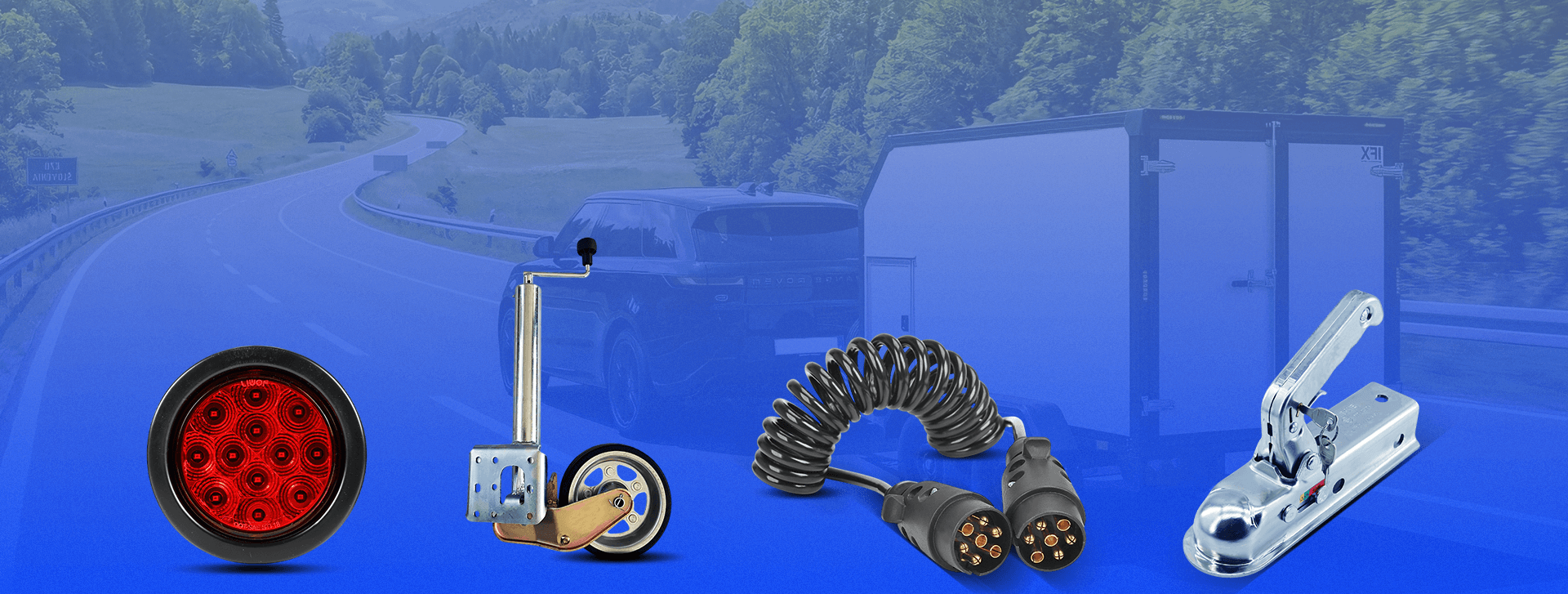
Why Trailer Manufacturers Are Moving Toward One-Stop Trailer Parts Suppliers
Time:September 7, 2026
Trailer manufacturing is becoming increasingly competitive.
For trailer manufacturers, distributors, and importers, the challenge is no longer simply finding a supplier that can offer a competitive unit price. What matters more is whether the supplier can provide stable quality, reliable lead times, technical support, consistent specifications, and flexible customization across multiple trailer components.
Traditionally, many businesses source different components from different factories:
This approach may appear to offer flexibility and competitive pricing. However, as purchasing volumes increase, the hidden costs of managing multiple suppliers become increasingly obvious.
More trailer businesses are therefore moving toward one-stop trailer parts suppliers that can provide multiple product categories under one supply chain.
This shift is not simply about convenience. It reflects a broader change in how trailer manufacturers manage quality, procurement efficiency, product development, compliance, and supply chain risk.
The biggest problem with multi-supplier sourcing is often not the purchase price.
It is the management cost behind the purchase.
Consider a trailer manufacturer purchasing five major component categories:
Supplier A → Trailer LED Lights
Supplier B → Couplers
Supplier C → Jockey Wheels
Supplier D → Wiring Harnesses
Supplier E → Trailer Accessories
Every additional supplier creates another communication channel, quotation process, production schedule, quality inspection process, and shipment arrangement.
This can result in:
For small-volume purchasing, these problems may be manageable.
But when a manufacturer is producing hundreds or thousands of trailers per year, procurement complexity can become a significant operational cost.
A one-stop trailer parts supplier can consolidate multiple product categories into a more centralized purchasing system.
Instead of managing five separate suppliers, the purchasing team may be able to coordinate most of these components through one experienced supplier.
The benefit is not simply fewer suppliers.
The real benefit is fewer processes to manage.
Trailer performance depends on the interaction between multiple components.
For example, lighting, couplers, jockey wheels, wiring systems, and mechanical components all contribute to the overall reliability and safety of a trailer.
When products come from different suppliers, quality standards can vary significantly.
One supplier may use a certain grade of stainless steel, while another uses a different material specification.
One supplier may have strict incoming material inspection, while another may rely mainly on final visual inspection.
Even seemingly small differences can become important over time.
For trailer manufacturers, quality consistency should therefore be evaluated across several areas:
The material used for tubes, brackets, fasteners, housings, and other components affects strength, corrosion resistance, and service life.
Stamping, welding, machining, assembly, sealing, and surface treatment all influence final product performance.
Components need to maintain stable dimensions to ensure proper installation and compatibility during trailer assembly.
Electrical products such as LED lights require appropriate electrical and waterproofing controls, while mechanical components such as couplers and jockey wheels require functional and load-related checks.
A product that performs well in one shipment but varies significantly in the next shipment creates additional risk for manufacturers.
A professional one-stop supplier with established quality control systems can help create more consistent standards across different product categories.
Trailer manufacturers often produce multiple trailer models.
A single company may manufacture:
Different trailer models may require different component combinations.
However, manufacturers generally benefit from standardizing as many components as possible.
For example, a manufacturer may use a defined range of:
Standardization can simplify inventory management and reduce the number of different SKUs required.
A supplier that can provide multiple compatible components can help manufacturers build a more organized product system.
Instead of purchasing individual components without considering the overall trailer configuration, the manufacturer can develop a more standardized component portfolio.
This becomes particularly valuable for companies that are expanding their product range.

Trailer manufacturers rarely remain completely static.
New trailer models are introduced. Existing products are modified. Customers request different mounting dimensions, cable lengths, connectors, packaging, labels, or branding.
This is where the difference between a trading supplier and an experienced manufacturer becomes important.
OEM development may involve details such as:
When these requirements are spread across multiple suppliers, communication becomes more complicated.
For example, changing a wiring harness specification may require coordination between the harness supplier, lighting supplier, and trailer assembly team.
Working with a supplier that understands several related trailer components can make these discussions much more efficient.
The supplier does not only receive a specification.
They can also understand how the component will actually be used on the trailer.
That difference can save significant development time.
Trailer components are increasingly influenced by regional regulations and market-specific requirements.
The requirements are not necessarily identical between markets.
For example, trailer lighting sold into different regions may need to consider different regulatory or approval requirements.
Depending on the market and product category, manufacturers may encounter requirements related to:
This means that purchasing decisions cannot always be based purely on price.
A component that is technically suitable for one market may not automatically be suitable for another.
An experienced international supplier can help customers identify the relevant requirements earlier in the product-development process.
This is particularly important for OEM projects.
It is generally much easier to consider compliance requirements before production begins than to discover a problem after a large batch has already been manufactured.
Packaging is sometimes treated as a minor purchasing detail.
For trailer parts distributors and importers, it can have a major impact on the overall business.
Products may require:
For retail-oriented products, packaging also affects shelf presentation and warehouse handling.
For OEM customers, packaging may need to match an existing brand system.
When multiple suppliers are involved, every supplier may use different packaging dimensions, carton specifications, labeling systems, and packing methods.
A one-stop supplier can help standardize these requirements across different product categories.
This can make warehouse receiving, inventory management, and final distribution easier.
Another important advantage is shipment consolidation.
Imagine purchasing:
from several different suppliers.
Each supplier may have a different production schedule.
This means the buyer may need to manage several shipments and different delivery dates.
If suitable products can be sourced from one supplier, there may be opportunities to consolidate products into fewer shipments.
This can potentially reduce:
Of course, consolidation is not always the cheapest solution. The best logistics method depends on order volume, product dimensions, urgency, and destination.
But having the option to consolidate products gives buyers more flexibility.
There is an important distinction here.
A professional one-stop trailer parts supplier should not simply claim to sell a large number of products.
What matters is whether the supplier has sufficient manufacturing capability, product knowledge, quality control, and supply-chain management to support those categories reliably.
A strong supplier should be able to answer questions such as:
In other words, one-stop sourcing should mean one reliable technical and supply-chain partner, rather than simply one company name on the invoice.
Before moving multiple product categories to one supplier, buyers should evaluate several factors.
Does the supplier have its own production facilities or control the manufacturing process effectively?
Can the supplier support multiple core trailer component categories?
Is there a structured quality control system rather than only final visual inspection?
Can the supplier help with product development and customization?
Does the supplier understand the regulatory requirements of the target market?
Can technical questions, specifications, drawings, packaging, and production issues be handled efficiently?
Can the supplier maintain consistent quality and delivery performance as order volumes increase?
Can the supplier provide customized products, packaging, labels, and wiring solutions when required?
These factors are often more important than simply comparing the lowest quotation.
The purpose of one-stop sourcing is not necessarily to eliminate every other supplier.
Instead, it is about creating a more efficient and controllable supply chain.
For trailer manufacturers and distributors, the value can be summarized in five areas:
Lower procurement complexity
Fewer supplier relationships can mean fewer communication and coordination tasks.
More consistent quality
Multiple product categories can be managed under a more unified quality system.
Faster product development
OEM specifications and customization can be discussed with a supplier that understands the broader trailer application.
Better supply chain visibility
Production, packaging, and shipment planning can be coordinated more efficiently.
Long-term technical partnership
The relationship can develop beyond individual transactions into product development and supply-chain cooperation.
The trailer industry is becoming more specialized.
Manufacturers need to control costs while maintaining product quality. Distributors need reliable products with predictable supply. Importers need suppliers who understand their target markets and compliance requirements.
At the same time, customers increasingly expect customization, shorter development cycles, professional technical support, and stable delivery.
This means that the role of a trailer parts supplier is changing.
The supplier is no longer simply a company that provides individual components.
The most valuable suppliers are becoming supply-chain partners that understand the complete trailer application.
For trailer manufacturers and distributors, choosing the right supplier can therefore have an impact far beyond the unit price of a single component.
Founded in 2009, Ningbo ERA Vehicle Co., Ltd. specializes in trailer components and provides sourcing and OEM solutions for customers in international markets.
Our product range includes:
With in-house manufacturing, engineering support, quality control systems, and experience serving international customers, ERA Vehicle works with trailer manufacturers, distributors, importers, and other trailer-related businesses.
Our goal is not simply to supply individual parts, but to help customers build a more reliable, efficient, and scalable trailer component supply chain.
If you are looking for a long-term supplier for trailer components, OEM projects, or wholesale purchasing, contact ERA Vehicle to discuss your requirements.
Because sourcing multiple components from different suppliers can increase communication, quality control, logistics, and inventory management costs. A reliable one-stop supplier can simplify these processes.
Yes. Experienced trailer component manufacturers and suppliers may provide products such as LED lights, couplers, jockey wheels, wiring harnesses, jacks, and other trailer accessories.
Not necessarily. The main advantage is not simply a lower unit price. It is the potential reduction in total procurement and supply-chain management costs.
Professional suppliers may support customized specifications, packaging, labels, wiring configurations, product development, and other OEM requirements depending on their manufacturing capabilities.
Consider manufacturing capability, quality control, product range, engineering support, market compliance knowledge, OEM capability, communication efficiency, and supply stability—not just the quoted price.
Looking for a reliable trailer parts supplier for your next project?
Contact Ningbo ERA Vehicle to discuss your product requirements, OEM specifications, and wholesale needs.
 +86 574 82002494
 info@eravehicle.com
